
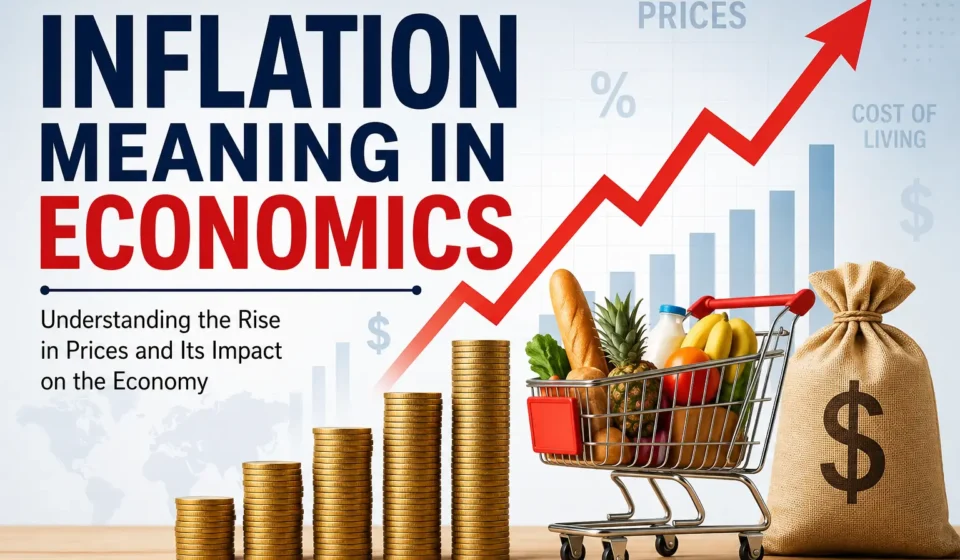
If your grocery bill feels bigger than last year — that is inflation at work. Here is what it actually means in economics, and how it shapes your financial life.What is inflation meaning in economics?
In economics, inflation means a general, sustained rise in the prices of goods and services across an economy over time. As prices increase, each unit of currency buys fewer goods — so your money’s purchasing power decreases.
Simple definition: Inflation = prices going up + money buying less. It is measured as a percentage over a set period, usually one year.
Inflation is not about one product getting expensive. It describes the overall price level of the whole economy — from food and fuel to rent and healthcare.
How is inflation measured?
Governments and central banks measure inflation using indices — baskets of everyday goods and services tracked over time. The four main measures are:
- Consumer Price Index (CPI) — Most widely used. Tracks prices of everyday household items: food, transport, clothing, utilities.
- Producer Price Index (PPI) — Tracks prices at the factory or wholesale level. Often an early signal of where CPI is heading.
- Core Inflation — CPI with food and energy removed. Less volatile, preferred by central banks for policy decisions.
- GDP Deflator — The broadest measure, covering price changes across everything a country produces.
The most widely reported figure globally is the CPI annual rate. When you hear “inflation is 4.2 percent,” it means prices on average are 4.2 percent higher than they were twelve months ago.
Main types of inflation

Demand-pull inflation
This happens when spending outpaces supply. Too much money chases too few goods, so prices rise. Consumer booms and large government stimulus packages are common triggers.
Cost-push inflation
When production costs rise — oil, raw materials, wages — businesses pass those costs on to consumers through higher prices. This type is harder to fix through demand management alone.
Built-in inflation
Workers expect prices to rise, so they demand higher wages. Businesses then raise prices to cover the wage increase. The cycle repeats. This self-reinforcing loop is why inflation expectations matter so much to central banks.
Hyperinflation
The extreme end — prices can double in days or weeks. It destroys savings and confidence in a currency overnight. Zimbabwe in 2008 and Germany in 1923 are the most cited examples. It is rare, but the damage is permanent.
Main causes of inflation
Understanding the inflation meaning in economics also means knowing what drives it. The main causes are:
- Excess money supply — When central banks print more money than the economy needs, each note buys less.
- High consumer demand — Spending that exceeds what the economy can produce pushes prices up.
- Supply chain disruptions — Shortages in raw materials or logistics force prices higher across multiple sectors.
- Rising energy costs — Fuel price increases ripple through manufacturing, transport, and agriculture simultaneously.
- Government borrowing — Large fiscal deficits can pump excess demand into the economy, adding inflationary pressure.
How inflation affects everyday life
Higher cost of living
Food, rent, transport, and utilities all become more expensive. Households on fixed incomes feel this the hardest, as their spending power erodes without any corresponding rise in income.
Savings lose real value
If inflation runs at 5 percent but your savings account earns 2 percent, you are losing 3 percent of purchasing power every year — even though the number in your account stays the same.
Interest rates rise
Central banks raise interest rates to cool inflation. That makes mortgages, personal loans, and credit cards more expensive. A decision made in a central bank boardroom directly affects your monthly repayments.
Wages may not keep up
When salary increases lag behind inflation, real purchasing power falls — even if you receive a pay rise. The number goes up, but what it buys goes down.
Asset prices often rise
Property and equities tend to hold value during inflationary periods. This benefits those who already own assets far more than those who do not.
Note: Mild inflation of around 2 percent per year is considered healthy. It encourages spending and investment rather than hoarding cash.
How governments control inflation
Monetary policy
Central banks — the US Federal Reserve, European Central Bank — raise interest rates when inflation climbs too high. Higher rates reduce borrowing, cool spending, and bring prices down. It works, but the effect takes months to filter through.
Fiscal policy
Governments can reduce public spending or raise taxes to take demand out of the economy. These are politically difficult moves, which is why central banks typically do the heavier lifting on inflation control.
Most major central banks target around 2 percent annual inflation. Not zero — because zero risks sliding into deflation, where falling prices cause people to delay purchases, demand collapses, and the economy stalls. Two percent is a
deliberate, carefully chosen balance.
Frequently asked questions
Is inflation always bad?
Not at all. Moderate inflation signals a growing, functioning economy. The problem arises when it climbs too fast, stays too high, or becomes unpredictable. The 2021 to 2023 global surge showed how quickly manageable inflation can become a serious economic problem.
What is the difference between inflation and deflation?
Inflation means prices rising. Deflation means prices falling. Deflation sounds appealing but is dangerous — when people expect prices to keep falling, they stop buying. Demand drops, businesses cut jobs, and a damaging cycle begins. Japan experienced this across much of the 1990s and 2000s.
Does inflation affect all countries equally?
No. Countries that import goods priced in US dollars tend to feel inflation more sharply when the dollar is strong or global commodity prices spike. Currency weakness amplifies everything. The same oil shock can cause mild inconvenience in one country and a genuine crisis in another.
What is stagflation?
Stagflation is high inflation combined with slow economic growth and high unemployment. It is particularly painful because the usual fixes conflict — raising rates to fight inflation slows growth further. The 1970s oil crisis produced stagflation across much of the Western world.
Key takeaways
- Inflation meaning in economics = a sustained rise in the general price level of an economy
- Inflation meaning in economics measured by CPI, PPI, core inflation, and the GDP deflator — reported as an annual percentage
- Main types: demand-pull, cost-push, built-in, and hyperinflation
- Around 2 percent annual inflation is the global benchmark for a healthy economy
- Central banks control inflation mainly through interest rate adjustments
- Inflation affects purchasing power, savings, wages, borrowing costs, and asset prices
- Developing economies often feel inflation more acutely due to currency and import exposure
Inflation is not a distant economic concept. It is in your rent, your fuel, your grocery run. Understanding how it works does not just make you better informed — it helps you make smarter decisions about your savings, your spending, and your plans.a
The next time you hear that inflation has risen or fallen, you will know exactly what that means — and why it matters.
Impact-Site-Verification: c4b21230-0195-4eb2-933b-e6a53c33eefb


[…] today’s economy with inflation, market ups and downs, and constant financial noise, Housel’s advice feels practical and […]